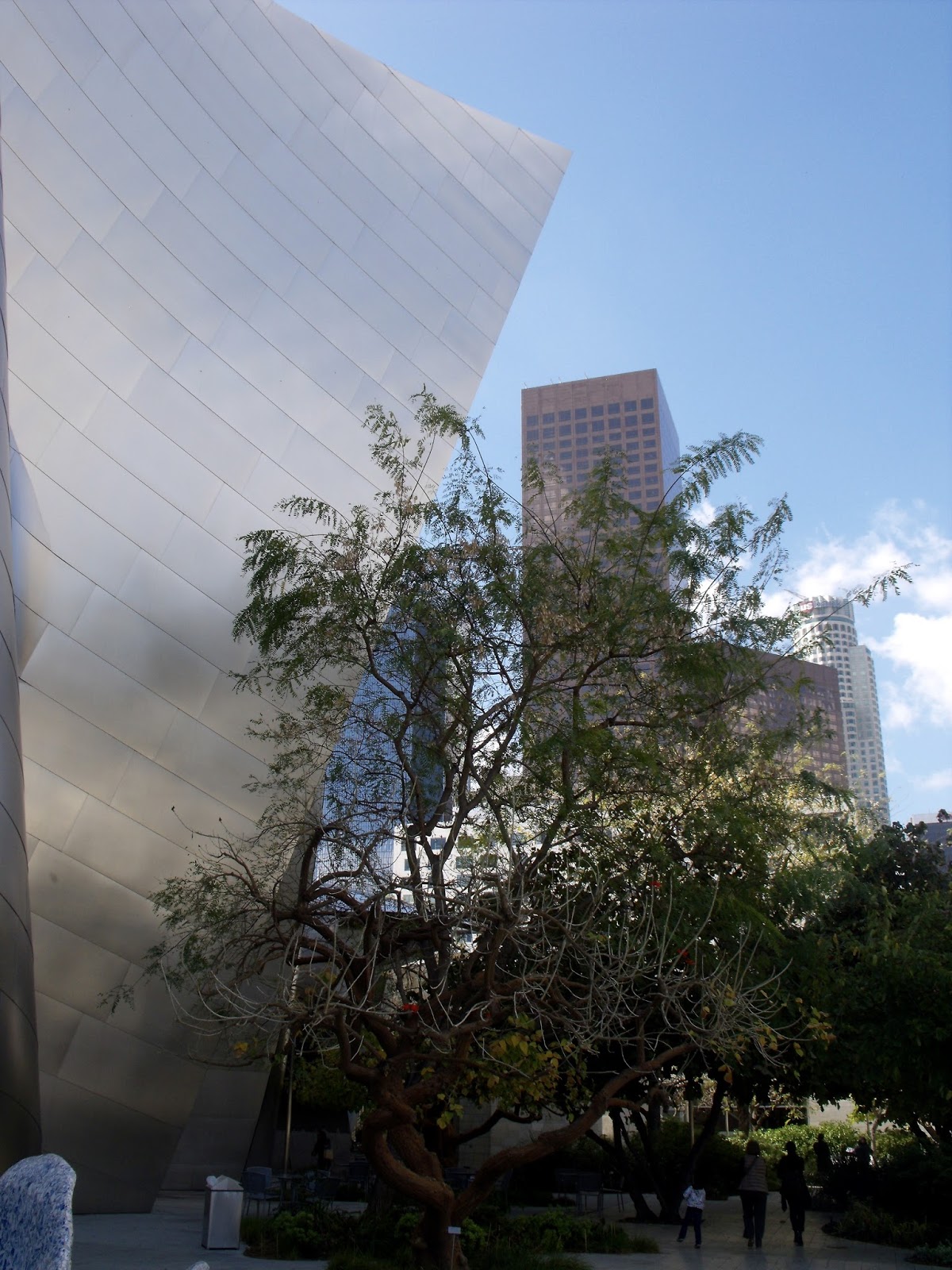
Wednesday, 30 March 2016

The Frank Gehry / Walt Disney Concert Hall, Los Angeles


I love this building. There's a wonderful public garden a floor up that extends around the back, too.


part of said garden


Wednesday, 16 March 2016

Hanne Bramness's No Film in the Camera (trans. Frances Presley, Shearsman, 2013)

Here are some favourite passages from this splendid book of prose poems:


Pools of dew swell with the coming of spring but it will soon freeze, because there is a sense of loss.

end of "1"


The floor is partially erased by the light, it is still possible to set out and get across. It is still possible to pull back, run home and put an end to this experiment.


end of "2"


Photographers do not spend their whole lives taking photos in order to recall surfaces, but what has happened just before or long before, and what will happen immediately afterwards.

end of "11"


The presence of the photographer is not really a threat, but a substitute for one.

from "15"


There are many who will not dissimulate, they sacrifice their smile.

end of "19"


She blushes and smiles with her whole body, as much as she possibly can. But trying so hard does not inspire confidence.

end of "20"


The photographer is hunting Europe's spring, along boulevard and pig sty, he wants to catch the light that deprives things of their value--meaning their place in a hierarchy.

end of "27"


If there is no sky in this picture it is still an image of the heavens.

end of "33"


There's no doubt, she is who she pretends to be. 

end of "67"


Some time during the night it happens, she takes a picture of the dream tree just as the clouds are ripped away from the moon.

end of "81"


A fruit tree with buds, stopped before they could unfold, not shrivelled, not dead, but transformed into an image of longing.

end of "77"


Like the ice, the photo keeps everything in place for a while. And the picture exposes the silence, but if you listen long enough it will break into a roar.

end of "82"


You can buy this illuminating book of prose poems directly from the publisher here


Sunday, 28 February 2016

Connie Voisine's Calle Florista (University of Chicago, 2015)

Connie and I are both graduates of the MFA program in creative writing at the University of California, Irvine, and I was glad to have her read to my students Thursday while she's spending her sabbatical in the UK. Here are some favourite passages from her new collection, Calle Florista:


There weren't flowers so much as

cats, at least a hundred, lounging in the neighbor's yard
while the bushes roiled with kittens.


from "Calle Florista"


Maybe the soul isn't a fussy eater--
still, it is ravenous

and expensive, like a defensive lineman.

from "I Admit that I Believe that Ideas Exist Regardless"


The book's perfume lifted as you touched it: must, dead clover, wood smoke. 
Your flesh became silk, limpid, luminous.

from "Annunciation"


The pond wants to be the sun that dumps its sugar on the grass.

*

The shoe wants to be the buckle that the girl shines with a cloth.
The buckle wants to be the magpie lifting what shines.

from "Testament"


The holy is 
otherwise,
nowhere. Where
the non-fog
waits in the 
no-cleft.

end of "After"


And of course night comes on
just as you desired. As do the wild pigs
snuffling in the desert, as do the wolves
spangled with hunger, and the hunger itself 
that lopes through my house.
Your desire is dark,
whoever you are, and igneously
formed by heat.
Cooling, it litters my slopes.

end of "Psalm to Whoever Is Responsible"


There aren't enough doves
in North America to fill
the gondola of you.
Onions are fallible, only
pretending to be infinite....

the opening of "A World's Too Little for Thy Tent,
A Grave Too Big for Me"


This country wakes to turn off the light,
and it's no other dark but yours.

end of "Prayer of the St. of the Hottest Night
in Las Cruces"


Remember, no matter how hard you tried,
there were no proper

shoes for this.

from "In the Shade"


Saturday, 20 February 2016

Michelle Detorie's After-Cave (Ahsahta Press, 2014)

Some favourite passages from the book I've just read, Michelle Detorie's first collection, After-Cave. Note I couldn't always recreate her spacing.

These come from the first section, "Fur Birds":


Each of us was asked to speak, and it was with reluctance and kindness that I lied.

*

We swing and twitch the tune, the lungs brimming.

*

The body is broken into parts and yet flows together like water.

*

I am animal; there is no becoming.

*

Your heart, it's a knot
of flames, a knave
of feathers. In
the dream sea, green
words flex and shiver. 


From the second section, "Feralscape":


A book is a room.
I am a house.

*

There are so many pink bones
                           in the yellow paper dress
                      a girl wears into the woods. In this story the trees
                           are sentences that blow away.

*

we sleekly become, without teeth
                              or tongue like
                          seam-ripped frocks:
          silky, frayed, gleaming: a continuance


from the last section, "The Data Is Feminine: After-Cave":


                             Your hair
was yellow then, a spool
of floss wound with light.

*

No sudden for the wintered.

*

You tell me that the pyramids were the product of collaboration, innovative project management, but I know already that what made them was slave labor--a capsized river of bones and blood.


The easiest way I found to obtain Detorie's After-Cave in the UK was through Abe Books here.

Wednesday, 17 February 2016

Plainwater by Anne Carson (Cape, 1995)

I didn't include any selections from the first section here as they work as brilliant versions of the original Mimnermus fragments. Perhaps I should reconsider. Anyway, here are my favourite passages elsewhere in the manuscript.


From Part II, Short Talks:


You can never know enough, never work enough, never use the infinitives and participles oddly enough, never impede the movement harshly enough, never leave the mind quickly enough.


the end of "Introduction"


Rembrandt wakens you just in time to see matter stumble out of its forms.

the end of "On the End"


From Part III, Canicula di Anna:


The fact that Anna is somewhere 
having coffee or a dream
is an assault on me.
I hate these moments of poverty.

*

Sound
that shines up as a laugh
and smells like blood
is another troublesome,
ancient
category.


From Part V, The Anthropology of Water:


...the only rule of travel is, Don't come back the way you went.

*

It would be an almost perfect love affair, wouldn't it? that between the pilgrim and the road. No mistake, it is a beautiful thing, the camino. It stretches away from you. It leads to real gold. Look at the way it shines. And it asks only one thing. Which happens to be the thing you long to give. You step forward. You shiver in the light. Nothing is left in you but the desire for perfect economy of action, using up the whole heart, no residue, no mistake: camino. 

*

...you drop through a freedom so clear it is simply pain.

*

Shapes of life change as we look at them, change us for looking.

*

What are we made of but hunger and rage? 

*

How surprised I am to be entangled in the knowledge of some other animal.

*

An entrance is important to a pilgrim: there can be only one.

*

No photographs--you know what fireworks are like. Tawdry, staggering, irresistible, like human love.

*

If we strain thought clear of impulse slowly, slowly the day scream subsides to ordered lust.

*

...a sun-drilled enormity of meadow....

*

I try to maintain a remote demeanour amid stunning self-accusations.

*

...little cats go clicking over the snow.


You can order Plainwater from Abe Books here.


Wednesday, 6 January 2016

Carmen Giménez Smith's Milk & Filth (University of Arizona Press, 2013)

Here are some favourite passages from this bold, thought-worthy book:


It sets wild into new fluencies.


"[Malinché]"


The jar houses my illusions

of eating men like hairballs.

end of "[Fragments from the Confessions]"


The charlatan was prelude

to the fracas I'd be.

Oh, those razor-sharp

appetites and their audacious

hullabaloo.

*

We met in the shadow

of his artificial interrogation

and wrested out the victories

from each other's defects.

from "[Wizardine]"


The blade was made

in the furnace where

excess is made and tiger

and where we sleep

like vampires when God

comes knocking.

She constructs a man

limb by limb from the earth,

and he belongs to us,

so we tear him apart

because he belongs to us.

from "[The Red Lady]"


I became the gelatin shiver of tea's

surface, that spent emotion.

from "[Susannah's Nocturne]"


Demeter became monster,

foul shame to motherhood.

We can be so insensitive

with others' losses when

they aren't our losses.

end of "[Hysteria]"


Poetry of regimented epigraphy smelled like fabric softener when I was young.

from "Parts of an Autobiography"


My cruel, divisive temperament: my cross

to bear. We all bear it because of our 

shared ancestry of milk and filth.


end of "Trigger Warning"


My parents can't describe me. All they ever see is assimilation and coconut. All they say is, "Why can't you just build yourself a Trojan horse into the big league?"

from "Can We Talk Here"


We're figures. We're lists of expenditure and food diaries,

but today I held the middle of me in hand and shook it.

It shook, shook like something fun.

from "Our Tiny Dimensions"


When God was a woman,

empire was meh.

the beginning of "When God Was a Woman"
The best way to purchase Milk & Filth in the UK is to order from Abe Books here.


Saturday, 2 January 2016

Seizing: Places by Hélène Dorion, translated by Patrick McGuinness (Arc, 2012), second selection

I'd like to begin my second and final set of selections from Hélène Dorion's Seizing: Places with two quotations from Patrick McGuinness's excellent introduction:

"Though Dorion's poetry has evolved, it has always been limpid and intense, sophisticated in its thinking but elemental in its feel for the world. It is also emphatic about poetry's role in knowing that world, in putting the world to words not in order to name it, pin it down and categorise it, but because expressing the world is also to experience it."

"'Writing does not protect me from life's turbulence, but rather takes me to its most precarious points of equilibrium, where the sense of provisionality is at its sharpest', she writes in her essay, 'The Poem's Detail'."

And now for passages from the poems:

                              Listen
to the years echoing behind you 
the storm blurs your vision, your hands
reach only for this furious past.
Everything is red, will soon be mauve.

*

You see the path: long rays
where the dramatis personae of your
unfinished lives are jostling. In your mouth
jaws suddenly close
on one of them.

*

You open the box where memory stirs.
...one by one, you find the stories again
--a crowd of images
fastens itself to every object. 

*

                                                    You open
a window and we breathe
the tiny leaves, branches, buds.

*

In Gursky's library
you turn the last page, it's the end
of the book, the world that's now contained
between the covers 
opens out then violently
shuts again on paths
you'll never tread
except in that rich
undefeated world of your books.
But each time, each time
your life will grow larger.

*

--so long as you hold
words in your hands
the garden where tonight, as every night
you open yourself to the wind's passage
will tell you what life really is.


from "Seizing: Windows"


Over the hill, a reddened
cloud grips that hour
when the soul settles--
and disperses.
As into myself, I enter
the cracked heart of dusk.

*

...slow cavities of hours.

*

Already the bank was fading
behind us, and far away, the brief
space where dream surges up.

*

          ...which 
is the place that is not a place
but that holds them all.

*

And for us the frail shelter invents
houses of fire and castles of sounds.

*

                                Each life
scatters its light
across time's room.

from "Seizing: Faces"


Thursday, 31 December 2015

For Love of 2015

I've had an extraordinary year. The only diminishment to the pleasure has been the inability to share any of it with my parents, especially my mother, my best friend, who I often used to speak to in my thoughts.

The first spectacular was the shortlisting of Imagined Sons for the Ted Hughes Award for New Work in Poetry by The Poetry Society--or, more specifically, the judges, Julia Copus, Kei Miller and Grayson Perry. For a manuscript first completed in 2006, honed nearly until publication in 2014, I was honoured and thrilled to receive national recognition.

Not long after the shortlisting, Susannah Herbert phoned to ask if I'd serve as a judge for the Forward Prizes in Poetry. The work proved exceptionally heavy--180 books, 225 poems (or thereabouts)--with a quick turnaround before the shortlist meeting. It was a treat to work with A.L. Kennedy, Emma Harding, Warsan Shire and Colette Bryce, and I learned so much about the way poetry collections operate, about the way they achieve integrity and excellence.

With the Forward prizegiving and celebration on 30 September and the new academic year commencing at the same time, I felt overwhelmed and delighted with my year in poetry. At the end of October I attended one of the most personally gratifying events of the year, with the launch of my late friend Linda Lamus's collection, A Crater the Size of Calcutta. Many publishers didn't want to touch a posthumous book by an unknown poet, but Mulfran Press took it on and produced a beautiful volume. The launch of the book in Bristol, with ten people who loved her reading a poem each, was perfect.


Yet there was more, relevant to my position teaching at Bath Spa University. To my delight, I received some teaching relief for the upcoming academic year, so while I'd be coordinating four modules, teaching PhD and undergraduate students doing independent studies, doing the usual load of moderation of marking for my own and other modules, and running the weekly first-year plenary series, I would not be teaching directly any individual modules and so not doing any large loads of marking. Instead of working five days a week for Bath Spa (I'm on a .7 contract, which means just under three-quarters' time), I would be working 2-3 days, so I'd have 4-5 days a week for my writing. Wa-hey! Further recognition came in December, with promotion to Reader in Creative Writing at Bath Spa.

I've had a splendid few months using the extra time the university's given me. I've been writing as much as possible, researching (this is the first book of poetry I've worked on that involved extensive research), and reading widely and voraciously. Thanks to my friends, colleagues, students and readers for your encouragement and support--I'm so grateful.


Here's to 2016!